

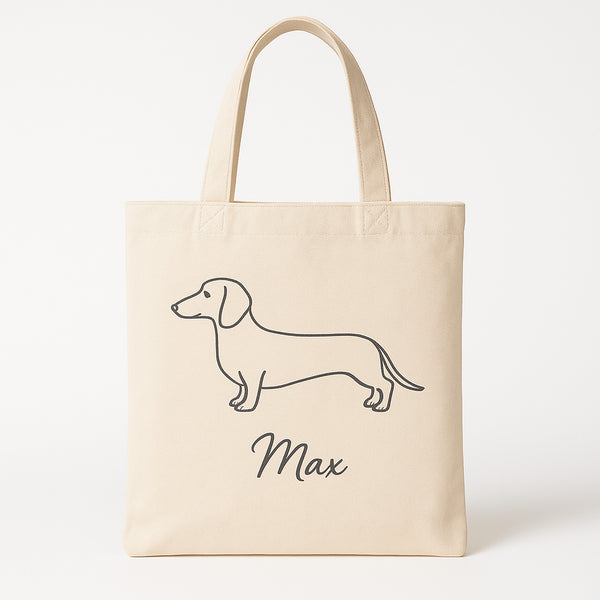

The pet portrait tote bag does one thing that a photo product cannot: it turns the dog into a drawing. A clean line-art portrait on natural cotton canvas, with the name underneath, reads as an illustration rather than a printed photo, which is why it gets carried to the shops rather than kept. The result depends almost entirely on the photo you send, so this is a guide to choosing it.
What the bag is
A compact everyday tote, about 20 cm wide and 25 cm high, in 100% natural beige cotton canvas with two flat cotton handles and an 18 cm drop, so it carries in the hand or on the shoulder. The design is printed on one side so it sits into the fabric with a soft, natural finish. It holds a book, a lunch, a purse and a lead: a shop-and-walk bag rather than a weekend bag.
Photos that convert well to line art
- Face towards the camera, or a clean side profile. Line art is about the outline of the head, the ears and the eyes. A three-quarter view with one ear hidden is harder to read.
- Even light, no harsh shadow. A shadow across half the face becomes a line across half the face.
- Plain background. Grass, a wall, a sofa. A busy background is fine for a photo and useless for a drawing, because the outline of the dog has to be found in it.
- Sharp. Whiskers, fur edges and eye highlights are what make the drawing look like that particular animal.
Photos that do not
- The dog asleep (no eyes, no outline).
- Mid-run, blurred.
- Taken from above while the dog looks up, which foreshortens the body into a head with feet.
- A black dog in a dark room. Black dogs draw beautifully in daylight and badly in the dark.
- Two pets in one photo unless they are side by side and both looking at the camera; otherwise send two photos and ask for a pair.
Cats, rabbits and the rest
Cats convert well because of the ears and whiskers; the same rules apply, and a sitting cat facing the camera is the easiest. Rabbits work in profile. Horses work as a head-and-neck profile. Anything with a strong outline draws well; anything that is mostly fluff (a very fluffy Pomeranian, a long-haired guinea pig) draws as a cloud with eyes, which some people love.
What to put under the portrait
The name, in a clean font. That is the design. If you want a second line: "Good boy", "Est. 2021", "Walks & treats", or the breed. Keep it to one colour, usually the same as the line art, so the bag stays an illustration. The font guide covers which style reads best in a single colour on beige.
Who it is for
The person whose phone is 80% dog. New puppy owners (send the eight-week photo). Dog walkers and groomers as a thank-you, with the dog's name. And the friend whose old dog has died: a line-art portrait from a favourite photo is a kinder object than a printed photograph, and it is used, not stored.
Washing
Hand wash gently in cool water and air dry flat; do not bleach, tumble dry or scrub over the print. Iron on the reverse if needed. Canvas softens with washing and the print softens with it.
Everything is made to order in Cheshire, usually dispatched within one to three working days, with free UK delivery. Because the bag is drawn from the photo you send, it cannot be returned for a different photo; if you are unsure whether a photo will work, email it to support@larencraft.com before ordering and we will tell you. More for the same person is in personalised gifts for pet lovers and the pet bandana.
Frequently asked questions
What photo works best for a pet portrait tote bag?
A sharp photo with the face towards the camera or a clean side profile, even daylight, and a plain background. Sleeping, blurred or top-down photos do not convert well to line art.
What size is the pet portrait tote bag?
About 20 cm wide by 25 cm high in natural cotton canvas, with 18 cm handles for hand or short shoulder carry. A shop-and-walk bag rather than a weekend bag.
Can I put two pets on one tote?
Yes, if they are side by side and both facing the camera in one photo. Otherwise send two photos and ask for a pair.


