
You have decided on the apron. You have paid for it, or you are about to. And now there is a text box on the screen with a blinking cursor in it, waiting for you to be clever.
This is where most people freeze.
The good news is that the wording is easier than it looks, and there are only really four decisions to make: who it is for, how funny you want to be, how long the text is, and whether it still makes sense in five years. Get those right and almost anything works.
Below are sixty ideas organised by recipient, plus the practical bits nobody tells you — like why a four-word phrase prints better than a nine-word one, and which jokes stop being funny by the second Christmas.
Start here: the four questions
1. Is it a gift or is it for you?
Gifts can be sentimental or funny. Aprons you wear yourself should be things you can still look at on a Tuesday morning in February. "World's Okayest Cook" is hilarious once. It is less hilarious on day four hundred.
2. Will they wear it in front of other people?
An apron worn alone at the hob can say anything. An apron worn at a family barbecue is, effectively, a T-shirt. Be careful with in-jokes that need explaining, and be very careful with anything mildly rude if there is a chance a grandmother will be present.
3. How long is the text?
Short wins. A name and a two-to-four word phrase is the sweet spot. Longer text has to shrink to fit the print area, which means it gets harder to read from across a kitchen — which is the only distance anyone ever reads an apron from.
4. Does it have a shelf life?
Dates, ages and job titles all expire. "Chef Since 2024" ages well. "Newly Qualified" does not. If the apron is a milestone gift, lean into the milestone. If it is meant to last, keep it timeless.
For Dad
Dads and aprons have a specific relationship, and it is mostly about barbecues. The joke is usually that he is more confident than he is competent, and the good news is that dads find this funny too.
- King of the Grill
- [Name]'s BBQ — Est. 2019
- Licensed to Grill
- Head Chef, Chief Washer-Upper
- Warning: Dad Is Cooking
- The Grill Father
- Sizzle Sergeant
- [Name]'s Kitchen — Compliments to the Chef, Complaints to the Dog
- Chief Burner of Sausages
- Dad. Legend. Grill Master.
For a Father's Day gift, a name plus a founding date reads as a keepsake rather than a joke — "Dave's Kitchen, Est. 1987" has more staying power than a pun. If you want the joke and the keepsake, put the name large and the pun small.
For Mum, Nan and Grandma
The instinct here is often to go sentimental, and that is usually right — but the best ones are specific. "Best Mum" is nice. "The Woman Who Taught Me to Make Gravy" is a gift.
- [Name]'s Kitchen
- Nan Knows Best
- Baking Since [Year]
- Grandma's Kitchen — Where Memories Are Made
- Head of the Sunday Roast Department
- Recipe Keeper
- [Name]'s Bakery — Established with Love
- Queen of the Kitchen
- The Original Head Chef
- Made With Love by Nan
A quiet tip for grandparent gifts: if there are grandchildren, use their names. "Made With Love for Ellie & Tom" turns a kitchen accessory into something that gets kept.
Funny and novelty
The rule with funny is that the joke has to survive repetition. Puns survive. Topical references do not. Anything involving wine survives indefinitely, apparently.
- I'm Only Here for the Free Food
- Season Everything, Trust No One
- This Is My Cooking Costume
- The Recipe Said Serves Four — I Live Alone
- Danger: [Name] Is Cooking
- I Cook With Wine. Sometimes I Add It to the Food.
- Whisk Taker
- Bakers Gonna Bake
- May Contain Traces of Panic
- Culinary Genius (Unverified)
- The Fire Alarm Is Just My Timer
- Kiss the Cook (Or Don't. I'm Busy.)
- Certified Sausage Turner
- I Followed the Recipe. The Recipe Was Wrong.
- Chief Taste Tester
If you are printing a long joke, break it across two lines. A punchline on its own line lands better and prints more cleanly than a single wrapping sentence.
For kids
Keep it short, keep it big, and let them read it themselves. A six-year-old wearing an apron with a joke they do not understand is not going to wear the apron.
- [Name]'s Baking Apron
- Little Chef
- Mixing, Making, Making a Mess
- Future Bake Off Winner
- Junior Chef in Training
- [Name] Helps
- Mum's Best Helper
- Warning: Sprinkles Everywhere
- [Name]'s Cake Lab
- Small Chef, Big Ideas
Names work harder than jokes for children. A child seeing their own name on something they wear is the entire gift.
For couples and matching sets
The trick with a pair is that each apron should work alone and work as a pair. "Salt" and "Pepper" is the archetype for a reason.
- Salt / Pepper
- The Chef / The Sous Chef
- Fish / Chips
- Cooks / Cleans
- Mr / Mrs
- Bake / Eat
- Grill Master / Grill Supervisor
- He Cooks / She Judges
- Established [Year] on both, with names beneath
For a wedding or anniversary, a shared date across both aprons is understated and holds up. For a housewarming, use the address.
For teachers, colleagues and thank-you gifts
Neutral, warm, and no in-jokes. This is a gift given in front of other people.
- Thank You for Everything
- [Name]'s Kitchen — With Thanks
- World's Most Patient Person
- Officially the Best
- [School/Team Name] — Thank You
- Made With Gratitude
What actually prints well
This is the part that catches people out, and it is worth two minutes of your time.
Bold and simple beats delicate and detailed. Apron fabric has texture. Very fine lines, thin script fonts and tiny text lose definition against it. A chunky sans-serif or a confident script at a decent size will always look sharper than an elegant hairline typeface shrunk to fit.
Fewer words, bigger words. Aprons are read from three metres away, usually while someone is holding a drink. If your text needs squinting at, the design has failed regardless of how good the joke was.
Contrast matters more than colour. Dark text on a light apron, or light text on a dark apron. Mid-tone text on a mid-tone apron looks fine on screen and disappears in a kitchen.
Check the spelling. Then check it again. Personalised items are made to order, which means they cannot be resold, which means they generally cannot be returned. A misspelled name is a permanent misspelled name. Read it out loud. Read it backwards. Get someone else to read it.
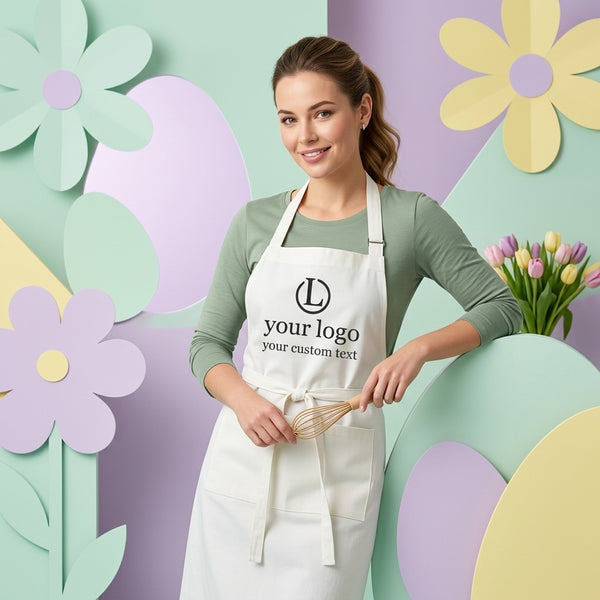
Logos need to be clean. If you are uploading a business logo, a high-resolution PNG with a transparent background will reproduce properly. A logo screenshotted from a website will not. Gradients, drop shadows and photographic detail rarely survive the transfer to fabric.
Choosing between name, quote, or both
If you are still undecided, this is the shortest possible decision tree.
Sentimental gift? Name, large. Optional small phrase beneath.
Funny gift? Phrase, large. Optional small name beneath.
Milestone? Name and date. Nothing else.
For yourself? Whatever you will still like in three years. Probably your name.
Business or team? Logo, plus first name if it is staff uniform.
The most common regret is not choosing the wrong joke. It is cramming a name, a quote, a date and an icon into one apron and ending up with something that reads as clutter.
Ready to make one?
Browse the full personalised aprons collection — every personalised apron at Laren Craft is printed to order in our Cheshire studio, so whatever you decide to write, it is made specifically for you. Choose your wording, pick your colour, and we will handle the rest.
For younger helpers, our personalised kids apron is sized for small chefs and works beautifully with a first name in large letters.
And if the apron is part of a bigger gift, a personalised photo mug alongside it turns one present into a set — the same name, the same date, the same handwriting, on the two things they will use every single day.
Frequently asked questions
How many words can you fit on a personalised apron?
As a practical maximum, around eight to ten words in total, split across two or three lines. Anything beyond that has to be printed small enough that it becomes difficult to read at normal viewing distance. A name plus a two-to-four word phrase is the most reliable combination.
Can you put a photo on an apron?
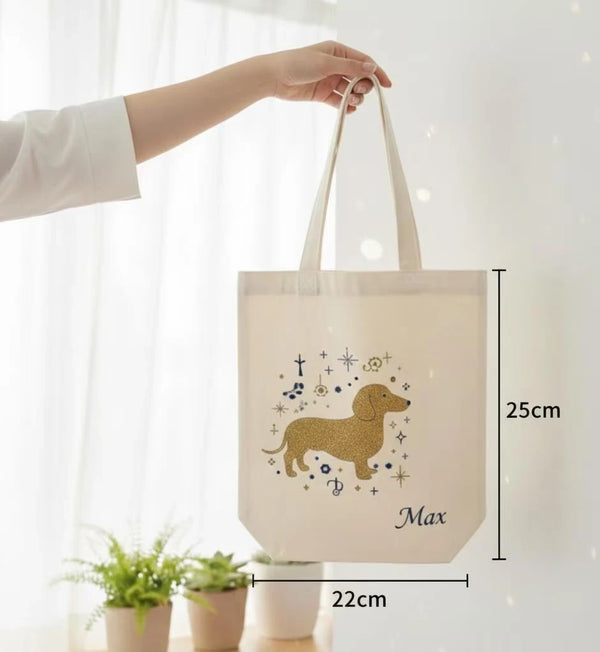
Yes, though photographs work best on light-coloured aprons and benefit from being high resolution. A clear, well-lit photo with a simple background reproduces far better than a busy group shot. Line-art portraits — a pet, a face, a house — often look more striking on fabric than a full photograph.
What is a good personalised apron message for someone who cannot cook?
Lean into it rather than away from it. "May Contain Traces of Panic", "Culinary Genius (Unverified)" and "The Recipe Said Serves Four" all work because they are self-aware. The gift lands better when the recipient is in on the joke.
Can you personalise an apron with a business logo?
Yes. Supply the logo as a high-resolution file with a transparent background where possible, and keep the design as a single flat colour or a small number of clean colours. Detailed gradients and photographic logos lose definition on textured fabric.
Are personalised aprons returnable?
Generally no, because they are made to order and cannot be resold. This is standard across UK personalised gift retailers. It makes double-checking your spelling before ordering genuinely important — faulty or incorrectly printed items are of course a different matter and should be replaced.